There are never enough trees, and that will always hold true, because humans have a tendency to disrupt nature’s balance. Even if, by some miracle, Pakistan’s forest cover increased to 25%, we could still destroy it in no time if we don’t change our mindset. But that’s no excuse to stop planting trees. In this blog, we’ll explore the many reasons why Pakistan needs more trees, now more than ever.
Lowest Forest Cover in The Region
Drastically, Pakistan’s forest cover is less than 4.8% of its total Land. While understanding how significantly low it is, India’s forest cover is 25,17% and Bhutan sits at around 70%.
One might ask, “What difference does a forest 100 or even 1,000 kilometers away make to my city?” Consider this: Earth is like a plate of biryani, every ingredient matters. Change the composition, and it no longer tastes the same. In the same way, forests far from us still play a vital role in the balance of our environment. We need trees, bees, birds, animals, everything a forest shelters. The only way forward is to grow more forests and let nature reclaim its space. Because when we remove trees from the Earth, we know what follows: irregular rainfall, floods, cloudbursts, heatwaves, anomalies we simply cannot and will not survive.
Urbanization Vs Green Space
A war green spaces are loosing over and over again. Below is the land use map of Lahore showing 1990, 2004 and 2018. This comparison is enough to shatter a heart that is filled with love of nature.
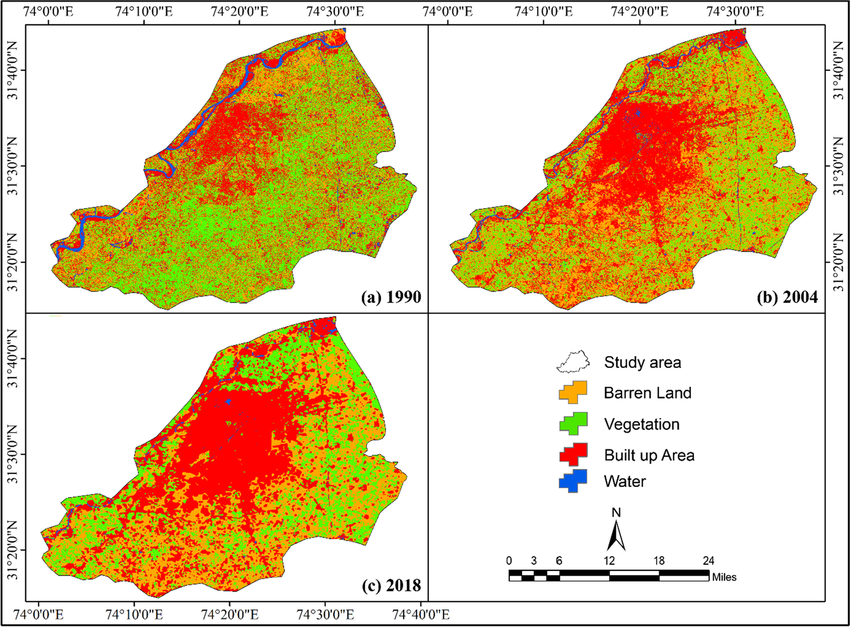
It is nothing short of a disaster. The surrounding land of Lahore is literally consumed by societies and irregular construction. It is not wrong to grow but while doing so, considering the balance that is keeping us alive is as important as any industrial complex or housing society.
Worst Air Quality In The World
Lahore takes the lead. With AQI crossing 1900 in November 2024, habitants were literally breathing toxic air. It resulted in closures of schools and life halted. Extremely harmful pollutants sent thousands in hospitals, PM2.5 in the air reached hazardous levels, crossing 450 µg/m³. The residents of Lahore could literally see pollution in the air, with visibility dropped significantly. It gave a glimpse of dooms day.
Heatwaves Are More Frequent
Record-breaking heatwaves are common now in Pakistan, cities like Dadu, Sibi and Jacobabad experienced temperatures exceeding 50°C. Urban areas like Lahore, Multan, Faisalabad also faced sever heat. According to a report by BBC, in only six days, more than 568 people died in Pakistan during a heatwave in 2024
Urban Flooding & Water Crisis
Due to deforestation and unplanned development, trees are being cut down at an alarming rate. Pakistan loses around 27,000 hectares of forest every year, which translates to approximately 21 to 32 million trees lost annually. To put that into perspective, that’s nearly 60,000 to 90,000 trees cut down every single day, or roughly one tree every second. Digest that!
This results in multiple outcomes:
- Soil erosion
- Landslides
- Faster runoff in monsoons
- Unexpected rain pattern
We recently witnessed urban flooding in Islamabad and Rawalpindi, where a flash flood on the morning of July 22, 2025, led to the tragic loss of four lives in the twin cities.
Pakistan Ranks 5th Most Climate-Vulnerable Country
The floods of October, 2022 killed 1739 people in Pakistan with staggering loss of US$40 Billion. Considering Pakistan’s GDP of US$374.8 billion at the time, it was a 10.7% of GDP. That was a huge amount to pay for the ignorance.
It’s surprising how vulnerable Pakistan is, yet the general public remains largely unaware of the scale of the threat. Climate change becomes an existential crisis when people begin to lose their lives, whether due to heatwaves, landslides, flash floods, or the lack of clean drinking water. In such moments, GDP losses mean little to the families of the deceased, though they too, feel the economic pain in both the short and long term.
Loss Of Biodiversity
Forests are worlds within our world. They are home to hundreds of thousands of living organisms. When forests disappear, birds, insects, and pollinators vanish or are displaced , causing irreversible damage to biodiversity. And if you observe closely, every organism is connected in a way that maintains a delicate balance. If that balance is lost, future generations won’t inherit the world we see today. It will be less colorful, less diverse.
Social Benefits
Green is natural stress repellant. Following are the key social benefits if we have more trees:
- Reduced stress, aggression & anxiety
- Access to green spaces results in better academic performance
If you’ve ever noticed, in regions where extreme heat lasts most of the year, people tend to behave more calmly and patiently in traffic jams during the winter months. This indicates that trees, shade, and green spaces could create a similar calming effect during the summer, simply by reducing heat and discomfort.
Whole Generation Loosing Connection With Nature
- Our children no more visit parks
- Mobiles and tablets have replaced outdoor activities hence lesser concern of parents for greenery
- Children, when disconnected with nature are prone to serious social, psychological and physical problems.
- Love of nature makes children humble and it reflects strongly in their teenage and older life
Conclusion
PodaKahani believes that planting trees is our strongest hope for giving our children a better future. While our fast-paced development will provide almost everything, it will lack the power to heal our souls, nature does that. Nature heals.
Pakistan’s polluted skies, shrinking forests, rising temperatures, and vanishing biodiversity are evidence of our negligence. But no matter what happened in the past, we have to start today. We have to plant more.
Every gesture matters in this movement. Whether you’re planting a forest or a single tree, you are a superhero for this Earth. Even a single word you say or write to inspire others is all that Mother Earth asks of you. At PodaKahani, we’re starting with just a few trees, and we’re going to keep going. We don’t expect a tsunami, but a steady wave of change that will meet the shore someday.